Not all transformation approaches are created equal—especially for growing SMEs navigating cost pressure, workforce challenges, and rapid change.
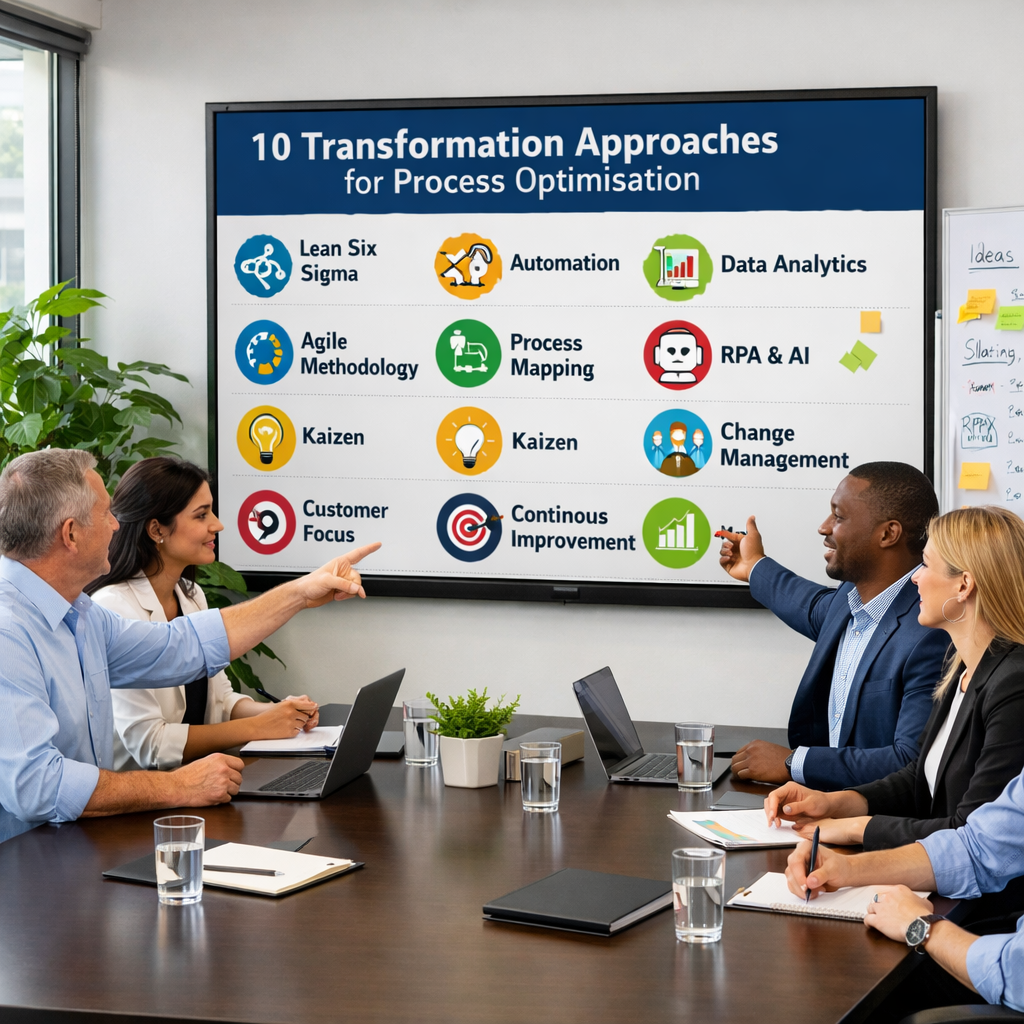
This guide breaks down 10 proven business transformation consulting approaches for complex process improvement, ranked by practicality, impact and suitability for Australian SMEs. Each includes clear use cases, decision triggers and how to balance people and digital considerations.
Why This Matters Right Now
For most SMEs, the issue isn’t just cost—it’s how the business actually runs.
- Processes evolve without structure
- Teams become reactive instead of efficient
- Systems don’t talk to each other
- Leaders hesitate to make changes due to risk
This is where business transformation consulting plays a critical role—bringing structure, clarity and measurable improvement.
The 10 Transformation Approaches
1. Business Process Reengineering (BPR) ⭐ Highest Impact
What it is:
A complete redesign of how work flows across your business—not incremental fixes.
Best for:
- Broken or inefficient end-to-end processes
- Rapid growth causing operational strain
- Legacy workflows no longer fit for purpose
Decision trigger:
“We’ve outgrown how we currently operate.”
People + Digital:
- Requires strong change management
- Often paired with system upgrades or integrations
2. Lean Process Improvement
What it is:
Removing waste and inefficiency to streamline operations.
Best for:
- High admin workload
- Repetitive tasks
- Resource-constrained teams
Decision trigger:
“We’re busy—but not productive.”
People + Digital:
- Empowers teams to improve processes
- Can integrate well with automation tools
3. AI-Led Process Optimisation
What it is:
Using AI to automate admin, reporting, communication, and decision support.
Best for:
- Manual processes
- Repetitive admin tasks
- Time-consuming reporting
Decision trigger:
“We’re doing too much manually.”
People + Digital:
- High ROI when applied practically
- Needs training and adoption support
4. Operational Excellence Frameworks
What it is:
A structured approach to continuously improving performance, efficiency and quality.
Best for:
- Businesses scaling operations
- Leadership teams needing consistency
- Organisations focused on long-term performance
Decision trigger:
“We need discipline in how we operate.”
People + Digital:
- Strong leadership alignment required
- Supported by reporting systems and dashboards
5. Digital Transformation Strategy
What it is:
Aligning business goals with the right technology and systems.
Best for:
- Disconnected tools
- Poor data visibility
- Scaling challenges
Decision trigger:
“Our systems aren’t supporting growth.”
People + Digital:
- Tech is only 50%—adoption is the real challenge
- Requires structured rollout and training
6. Workforce Structure Redesign
What it is:
Aligning roles, responsibilities, and capacity to business needs.
Best for:
- Overstaffed or underutilised teams
- Role confusion
- Leadership bottlenecks
Decision trigger:
“We’re not structured for how we actually work.”
People + Digital:
- Highly people-focused
- Often reveals automation opportunities
7. Systems & Workflow Integration
What it is:
Connecting tools and systems to reduce duplication and manual work.
Best for:
- Businesses using multiple platforms
- Manual data entry
- Reporting inconsistencies
Decision trigger:
“Our systems don’t talk to each other.”
People + Digital:
- Reduces admin load significantly
- Improves data accuracy and visibility
8. Change Management Programs
What it is:
Structured approach to implementing change without disrupting the business.
Best for:
- Large changes (systems, structure, strategy)
- Teams resistant to change
Decision trigger:
“We’ve tried to change before—it didn’t stick.”
People + Digital:
- Critical for adoption
- Ensures long-term success of transformation
9. Continuous Improvement Programs
What it is:
Embedding small, ongoing improvements into daily operations.
Best for:
- Mature teams
- Businesses wanting sustainable optimisation
Decision trigger:
“We want to keep improving—not just fix things once.”
People + Digital:
- Strong cultural component
- Supported by tracking tools and metrics
10. Outsourcing & Offshoring Strategy
What it is:
Shifting non-core work to external providers.
Best for:
- Cost pressure
- Non-strategic tasks
- Capacity constraints
Decision trigger:
“We’re spending too much time on low-value work.”
People + Digital:
- Needs careful management
- Works best with strong internal processes
How to Choose the Right Approach
Most SMEs don’t need just one approach—they need a combination.
A practical starting point:
- Assess structure and risks
- Identify inefficiencies
- Prioritise quick wins
- Implement scalable solutions
Final Thought
Most businesses don’t have a cost problem—they have a process and structure problem.
The right business transformation consulting approach isn’t about complexity—it’s about making your business easier to run, more efficient, and ready to scale.